




Analysis of the Relationship between Purge and Trap and Static Headspace
Published Time:
2022-07-28
Author:
Source:
Summary
Purge-trapping analysis is also known as dynamic headspace.
If there is dynamic, there will be static. What is the relationship between the two?
Dynamic headspace involves passing an inert gas through a liquid sample (or solid surface) to purge out the components to be analyzed, enriching them by passing through a container filled with an adsorbent. Then, the adsorbent is heated to desorb the adsorbed components, which are then carried by a carrier gas into a gas chromatography column for analysis.
Purge-and-trap analysis is suitable for extracting volatile or semi-volatile organic compounds with boiling points below 200℃ and solubility less than 2% from liquid or solid samples. It has an enrichment function, which is beneficial for the analysis of trace components. The purge-and-trap method does not require the use of organic solvents for sample pretreatment, does not cause secondary pollution to the environment, and has advantages such as small sample volume, high enrichment efficiency, low matrix interference, and easy online detection. However, the purge-and-trap method is prone to foam formation, leading to instrument overload. It also requires more time, and there is a possibility of introducing impurities during purging, as well as considerations for adsorbent selection. Furthermore, accompanying the purging of water vapor, water also has a quenching effect on flame detectors.
Static headspace analysis is widely used for the analysis of volatile substances in environmental samples such as soil, sludge, and water. For example, trichloromethane, carbon tetrachloride, trichloroethylene, tetrachloroethylene, tribromomethane in water. It is also widely used for solvent residue analysis in the pharmaceutical industry.
Compared to static headspace, the similarity between the two is that both use nitrogen or helium, or other inert gases to extract the analytes from the sample.
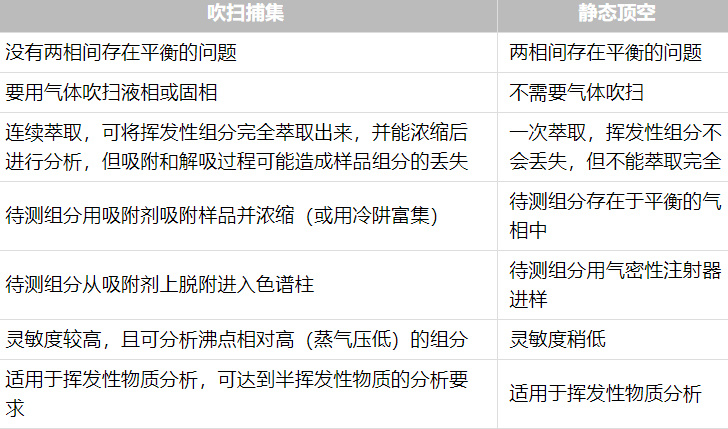
Of course, there are also differences. See the diagram below for detailed differences:
However, whether dynamic or static, the purging temperature of the sample. Aqueous solutions are mostly purged at room temperature, and as long as the purging time is long enough, the analytical requirements can be met. Also, the purge gas flow rate depends on the concentration of the analyte in the sample, its volatility, its interaction with the sample matrix (such as solubility), and its adsorption capacity in the trap tube. Purging time is one of the important parameters of purge-and-trap technology and must be optimized according to the specific sample. In principle, the longer the purging time, the higher the analytical reproducibility and sensitivity.
Recommended
How to perform injection operation for purge and trap?
2021-02-02
What is the basis for purge and trap not having cross-contamination?
2021-01-08
9 Major Usage Precautions for Gas Samplers
2023-02-23
Contact Information
Service Hotline
Address
Room 801A, Building A, U Valley Innovation Center, Xingmao 1st Street, Tongzhou District, Beijing

Official Account
Video Account