




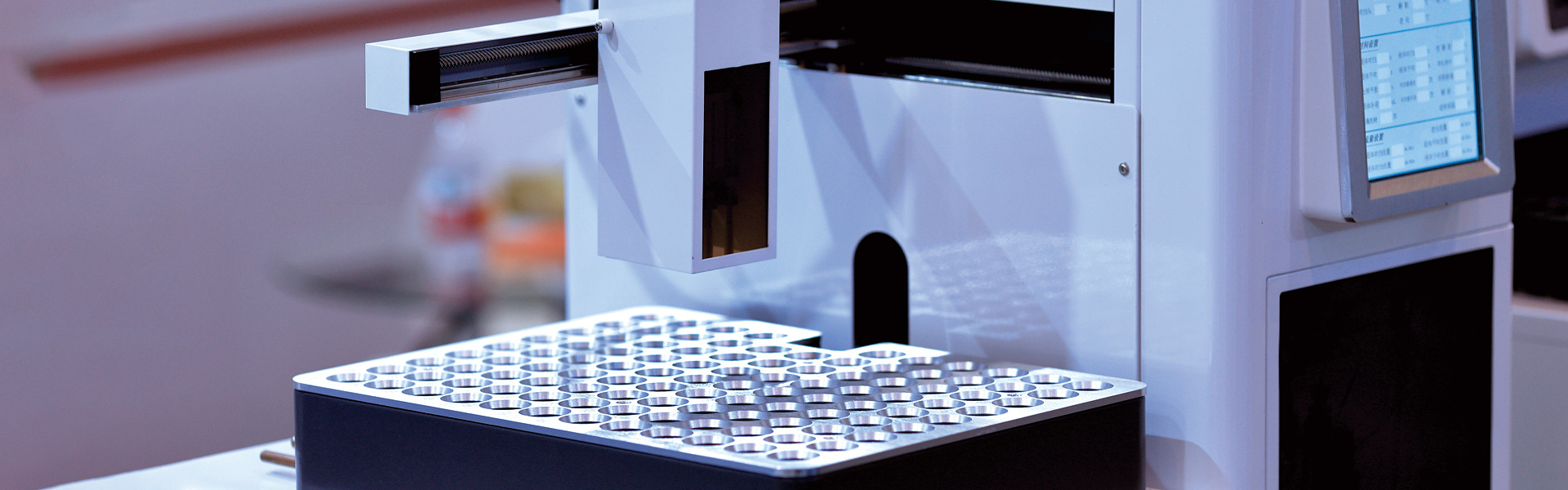
Fully automatic headspace sampler operation guide, please check.
Published Time:
2020-12-30
Author:
Source:
Summary
Automatic headspace sampler headspace sampling is divided into solution headspace and solid headspace. The former involves dissolving the sample in a suitable solvent, placing it in a headspace vial and incubating for a certain period, allowing the residual solvent to reach gas-liquid equilibrium, and quantitatively taking the gas for injection and measurement. Solid headspace involves directly placing the solid sample in a headspace vial and incubating it at a certain temperature for a certain period, allowing the residual solvent to reach gas-solid equilibrium, and quantitatively taking the gas for injection and measurement.
The automatic headspace sampler uses buttons or a touchscreen to set parameters. After each injection is completed, the system automatically uses inert gas to purge the sampling line and quantitative loop to prevent cross-contamination. From the sample to the instrument's injection port, the entire system is heated to eliminate cold spots, reduce sample peak broadening, and increase resolution. This makes sample analysis more precise. The number refers to the quantity of sample positions.
The headspace sampler controls the chromatograph to achieve automatic operation, continuous analysis, and unattended operation, maximizing work efficiency. However, it requires the gas chromatograph to have reverse control software, meaning the gas chromatograph software can control the main unit.
Automatic Headspace Sampler Operating Procedures
1. Set parameters and place samples. Set the "sample," "valve box," and "line" temperatures. The sample temperature is 50 degrees, the valve box 130 degrees, and the line 140 degrees. After the temperature stabilizes, place the samples, and after 30 minutes of equilibration, proceed with the following operations.
2. Purge before injection. Set the purge pressure to 0.2-0.3 Mpa. Press the purge button, and close it after about 30 seconds.
3. Prepare for injection. First, insert the sampling tube into the corresponding vial, then insert the injection tube into the chromatograph's injection port. Observe the headspace sampler's pressure reading, which will increase from small to large. When stable, adjust the "carrier gas adjustment" knob to increase the pressure reading by one increment (0.02 Mpa).
4. Inject, start sampling. Press "Inject" and simultaneously operate the chromatograph to start sampling. Listen for a "click" then a "thud" sound. After 2-3 seconds, remove the sampling tube.
5. Pull out the injection tube. When you hear a "thud," the injection light goes off, and you pull out the injection tube. Reset "carrier gas adjustment" to zero.
6. After purging for 30 seconds, this injection is complete.

Precautions for Operating and Using an Automatic Headspace Sampler
1. Since the carrier gas entering the headspace also enters the GC, the gas used for headspace should also be purified.
2. The heating temperature of the headspace vial, the quantitative tube temperature, and the transfer line temperature should increase from small to large, with the transfer line temperature being less than or equal to the injection port temperature.
3. When applying headspace, the total GC gas flow should be the headspace gas flow plus the GC gas flow; attention should be paid when calculating the split ratio. It can be calculated after measurement with a flow meter.
4. In time settings, the time for the sample to fill the quantitative tube should be sufficient, the equilibration time of the quantitative tube should not be too long, and the injection time should be long enough.
5. If the pressure adjustment of the headspace sampler is manual, after establishing the method, the sample pressurization and carrier gas pressure values should be recorded to prevent pressure changes due to valve state changes.
Recommended
How to perform injection operation for purge and trap?
2021-02-02
What is the basis for purge and trap not having cross-contamination?
2021-01-08
9 Major Usage Precautions for Gas Samplers
2023-02-23
Contact Information
Service Hotline
Address
Room 801A, Building A, U Valley Innovation Center, Xingmao 1st Street, Tongzhou District, Beijing

Official Account
Video Account